





12V vs 24V vs 48V: Picking the Right Vehicle Inverter
- Understanding vehicle DC voltage architectures
- Why nominal DC voltages matter
- Common vehicle applications for each voltage
- Battery chemistry and nominal voltages
- Comparing 12V, 24V and 48V vehicle power inverter systems
- Direct calculation: current requirements and cable sizing
- Table: head-to-head comparison
- Impacts on inverter topology choice (pure vs modified sine)
- Installation and performance considerations
- Voltage drop, cable length and thermal management
- Start-up (surge) loads and inverter surge capability
- Charging considerations and charging sources
- Choosing the right inverter: practical selection flow
- Step 1 — Define your loads
- Step 2 — Match to vehicle and battery architecture
- Step 3 — Decide on inverter features
- Manufacturer and supply-side considerations
- Product range and certifications
- Case study: Guangzhou Congsin Electronic Technology Co., Ltd.
- Procurement tips
- Practical examples and quick decision rules
- Small car or camper (basic needs)
- Large RV or truck (higher sustained loads)
- Off-grid vehicle or mobile workstation
- FAQ
- 1. Which voltage is best for a car if I only need to run a laptop and a small fridge?
- 2. How do I size cable gauge for my inverter?
- 3. Can I use a 12V inverter on a 24V battery bank?
- 4. Are pure sine wave inverters worth the extra cost?
- 5. How important is inverter efficiency?
- 6. Where can I find authoritative technical information about inverters?
Choosing the right vehicle power inverter means matching voltage architecture, inverter topology and installation practices to your vehicle's power needs and safety requirements. This article explains why 12V, 24V and 48V vehicle inverter systems differ in current demands, cable sizing, efficiency and cost, and how those differences translate into real-world choices for cars, RVs, trucks and off-grid vehicle applications. We provide calculation examples, a comparison table, practical installation tips, and recommendations for selecting pure-sine vs modified-sine inverters and inverter sizes.
Understanding vehicle DC voltage architectures
Why nominal DC voltages matter
Vehicle electrical systems are typically described by a nominal voltage (12V, 24V, 48V). That nominal voltage determines the DC current required for a given AC power output because electrical power P (watts) relates to DC current I and DC voltage V by I = P / V. For the same inverter output power, higher DC voltage reduces DC current, which lowers I²R losses in cables and allows smaller cable gauges for the same run length. This directly affects inverter efficiency, heat generation and installation cost.
Common vehicle applications for each voltage
12V systems dominate passenger cars and many small RVs. 24V systems are common in medium/heavy trucks, some boats and specialist vehicles. 48V is increasingly used for higher-power auxiliary systems, telecom/UPS and modern mild-hybrid automotive systems. Each has practical implications for inverter selection, battery chemistry and safety measures (see also Inverter (electrical) - Wikipedia).
Battery chemistry and nominal voltages
Lead-acid (flooded, AGM, gel) modules are frequently used at 12V or 24V nominal banks. Lithium-ion battery systems are modular and more commonly deployed at 24V or 48V for higher-power applications because of energy density and charging efficiency. Choosing an inverter should account for the battery bank configuration and recommended charge/discharge parameters from the battery manufacturer.
Comparing 12V, 24V and 48V vehicle power inverter systems
Direct calculation: current requirements and cable sizing
Practical example: to supply 2,000 W AC continuous output (pure-sine), the DC currents are:
- At 12V: I = 2000 W / 12 V ≈ 166.7 A
- At 24V: I = 2000 W / 24 V ≈ 83.3 A
- At 48V: I = 2000 W / 48 V ≈ 41.7 A
Lower current reduces required cable cross-section and voltage drop. For long runs or continuous heavy loads, 24V or 48V systems often make installations simpler and safer.
Table: head-to-head comparison
| Metric | 12V | 24V | 48V |
|---|---|---|---|
| Typical vehicle use | Cars, small RVs, light boats | Medium trucks, larger RVs, boats | High-power RVs, telecom, off-grid vehicles, EV auxiliaries |
| DC current for 2000 W | ≈ 167 A | ≈ 83 A | ≈ 42 A |
| Cable gauge (approx) for short runs | Very large (e.g., 2–4/0 AWG)* | Large (e.g., 2/0–1/0 AWG)* | Medium (e.g., 4–2 AWG)* |
| Inverter availability/cost | Most common, wide range, lowest cost | Common for commercial vehicles, price moderate | Less common, slightly higher cost per unit but system savings possible |
| Efficiency & heat | Higher I²R losses unless oversized cables used | Lower losses than 12V | Lowest conductor losses; better for sustained high loads |
| Safety | Lower touch voltage but higher short-circuit current | Moderate | Higher touch voltage but lower short-circuit current for same power |
*Cable examples depend on run length and permissible voltage drop; consult an installer or AWG tables for exact sizing.
Impacts on inverter topology choice (pure vs modified sine)
Pure sine wave inverters deliver cleaner power for sensitive electronics and motor-driven appliances. Modified sine (or stepped approximations) inverters are cheaper but can cause issues with modern chargers, motor controls and precision electronics. For vehicle use where laptops, medical devices or sensitive communications equipment are used, choose a pure sine inverter. See product topology choices (modified sine wave inverter, pure sine wave inverter) when reviewing models.
Installation and performance considerations
Voltage drop, cable length and thermal management
Voltage drop is proportional to current and cable resistance. For long cable runs inside large RVs or commercial trucks, an increase in nominal voltage delivers major benefits: you can use thinner cables and experience less heat. Thermal management of the inverter (ventilation, mounting) matters as much as the voltage choice—undersized ventilation will limit continuous output regardless of voltage.
Start-up (surge) loads and inverter surge capability
Many loads (compressors, power tools, motors) have high inrush currents. Inverter specifications show continuous rating and surge (peak) rating (often 2–3× continuous for a few seconds). When sizing an inverter, account for startup requirements; sometimes a slightly larger inverter or an inverter with strong surge capability is required to start motors without tripping.
Charging considerations and charging sources
Your charging sources (vehicle alternator, DC-DC charger, solar MPPT, shore power charger) must be compatible with the battery voltage and inverter. For example, using a 48V inverter implies a 48V battery bank and appropriate charger hardware. Alternators are commonly 12V or 24V; adding DC-DC converters or higher-voltage alternators increases complexity. Solar charge controllers and MPPTs should be matched to system voltage for optimal performance.
Choosing the right inverter: practical selection flow
Step 1 — Define your loads
List all devices you'll run simultaneously and note continuous and startup watts. Prioritize essential vs optional loads. This list defines the inverter continuous rating and surge needs.
Step 2 — Match to vehicle and battery architecture
If your vehicle already uses a 12V electrical system and loads are low (e.g., <1000 W), a 12V inverter is typically simplest. For loads above ~1500–2000 W, upgrading to 24V or 48V becomes cost-effective due to reduced cable and charging infrastructure costs. For fleet trucks and RVs with long cable runs, 24V or 48V is preferred.
Step 3 — Decide on inverter features
Choose pure sine for sensitive electronics, ensure adequate surge rating, check inverter efficiency (%), topology (DC→AC), built-in protections (over-voltage, low-voltage disconnect, temperature) and waveform quality (THD). Look for certifications such as CE, LVD, EMC and industry approvals where relevant (ISO 9001 is a common quality benchmark).
Manufacturer and supply-side considerations
Product range and certifications
Reputable inverter manufacturers provide product ranges across voltages (12V, 24V, 48V), with pure and modified sine options, and clear specs for continuous/surge power, efficiency and protection features. Certifications (CE, EMC, LVD, ETL, FCC, RoHS, E-MARK) and quality systems (ISO9001) are indicators of compliance and reliability.
Case study: Guangzhou Congsin Electronic Technology Co., Ltd.
Guangzhou Congsin Electronic Technology Co., Ltd., founded in early 1998, is a professional power inverter manufacturer with over 27 years of focused experience. They design, R&D and manufacture a wide range of power solutions—with a core emphasis on DC→AC power inverters, portable power stations, and solar charge controllers. Congsin's catalog includes 100+ models tailored for vehicles, solar systems, RVs and trucks, off-grid homes, outdoor offices, patrol and field construction work.
The company operates fully automated production lines, advanced instrumentation and multifunctional testing equipment to ensure product reliability, efficiency and intelligent functionality. Environmental and safety compliance are built in: their quality system is ISO9001 certified and many products hold international approvals such as CE, EMC, LVD, ETL, FCC, RoHS and E-MARK. Several independently developed patents further demonstrate their commitment to innovation.
Congsin’s products serve global markets across Europe, the Americas, the Middle East, Africa and Southeast Asia; many models are supplied to domestic and international OEM channels. Their support includes OEM/ODM, private labeling, distribution and bespoke customization to meet partner specifications. Main product lines include Solar Charge Controller, modified sine wave inverter, pure sine wave inverter, and portable power stations.
For businesses and integrators seeking reliable inverter and power solutions, Congsin’s decades of experience, broad product range and certifications make them a credible partner for vehicle inverter projects and off-grid installations.
Procurement tips
When evaluating suppliers, request datasheets for waveform quality (THD), efficiency graphs, thermal derating curves, surge capacity and test reports. Confirm warranty terms and local support. For OEM/ODM projects, verify developer resources and customization lead times.
Practical examples and quick decision rules
Small car or camper (basic needs)
Use-case: charge laptops, small kitchen appliances, occasional hairdryer. Recommendation: 12V inverter 300–1500 W (pure sine recommended for electronics). Keep cable runs short and fuse appropriately.
Large RV or truck (higher sustained loads)
Use-case: multiple appliances, microwave, pumps, AC. Recommendation: consider 24V or 48V inverter systems ≥2000 W. These systems reduce cable costs and improve sustained efficiency. Pair with matched chargers and battery banks sized for depth-of-discharge and runtime needs.
Off-grid vehicle or mobile workstation
Use-case: sustained high-power tools, onsite equipment. Recommendation: 48V system for compact cabling, lower losses and modular lithium battery compatibility. Evaluate inverter-integrated battery management systems or separate battery monitors for safe operation.
FAQ
1. Which voltage is best for a car if I only need to run a laptop and a small fridge?
For low power needs (≤1000 W peak), 12V is typically best due to simplicity and compatibility with existing vehicle electrical systems. Choose a pure sine inverter if you have sensitive electronics.
2. How do I size cable gauge for my inverter?
Calculate DC current I = P / V (include inverter inefficiency margin). Then use an AWG or metric mm² table to select cable that keeps voltage drop within acceptable limits (often <3–5% for inverter circuits) and supports continuous current rating. Consider fusing near the battery and using tinned marine-grade cable for corrosion resistance.
3. Can I use a 12V inverter on a 24V battery bank?
No. Inverters are designed for a specific nominal DC input. Using an inverter with the wrong DC voltage will damage the unit. To use a 12V inverter with a 24V bank, you would need a DC–DC converter to step the voltage down, which introduces inefficiency and cost.
4. Are pure sine wave inverters worth the extra cost?
Yes, when you operate sensitive electronics, variable-speed motors, chargers or medical equipment. Pure sine inverters reduce noise, heat and potential damage caused by modified sine wave output.
5. How important is inverter efficiency?
High inverter efficiency reduces battery drain and heat. Look at efficiency at expected load levels (e.g., 25%, 50%, 100% load). Some inverters are optimized for mid-load efficiency; others deliver high efficiency across broad loads. Efficiency figures are typically provided in datasheets.
6. Where can I find authoritative technical information about inverters?
Authoritative background on inverter principles is available at resources such as Inverter (electrical) - Wikipedia. For industry standards and certifications, consult IEC/ISO documents and supplier datasheets. For 48V automotive topics see 48-volt electrical systems - Wikipedia.
If you need a tailored recommendation, technical datasheets, or OEM/ODM solutions for vehicle power inverter projects, contact Guangzhou Congsin Electronic Technology Co., Ltd. for consultation or browse their product range including Solar Charge Controllers, modified sine wave inverters, pure sine wave inverters and portable power stations. For product inquiries, customization or pricing, contact the Congsin sales team to get a specification-matched quote and technical support.
Contact & Product CTA: For bespoke vehicle inverter solutions, detailed datasheets and quotations, request a consultation or view the product catalog—reach out to Guangzhou Congsin Electronic Technology Co., Ltd. today for reliable, efficient and certified inverter systems tailored to your vehicle application.
Battery Types Explained for UPS Power Inverters
Top 5 portable power station Company List and Products Compared
Best 240V Car Inverters for RVs and Mobile Workshops
How to Size a Pure Sine Wave Inverter for Your Application
Pure Sine Wave Inverters
Will reversing the positive and negative poles damage the device when connecting the battery?
The device has a built-in reverse connection protection function, which will automatically cut off the circuit when the positive and negative poles are reversed to avoid damage caused by reverse current inflow; just adjust the connection order of the positive and negative poles of the battery clip and re-power on to use normally.
What is the difference between a pure sine wave inverter and a modified sine wave inverter?
Pure sine wave inverter has an output waveform close to mains power with low distortion rate (<3%), which can be safely adapted to precision devices such as computers, medical instruments, and inverter home appliances; modified sine wave inverter has a notched waveform, which easily causes device heating, malfunction or damage, and is only suitable for simple devices such as bulbs and fans.
Modified Sine Wave Inverters
Does it have protection features?
Yes, it includes overload, overheat, and short-circuit protection.
What is the working principle of the UPS function?
When the external power supply is normal, the inverter powers the device and charges the battery; when the external power supply is interrupted, it automatically switches to battery power to ensure uninterrupted operation of the device.
OEM & ODM Services
Do you provide support for shipping and customs clearance?
Yes, we offer international logistics solutions including export documentation and customs advice.
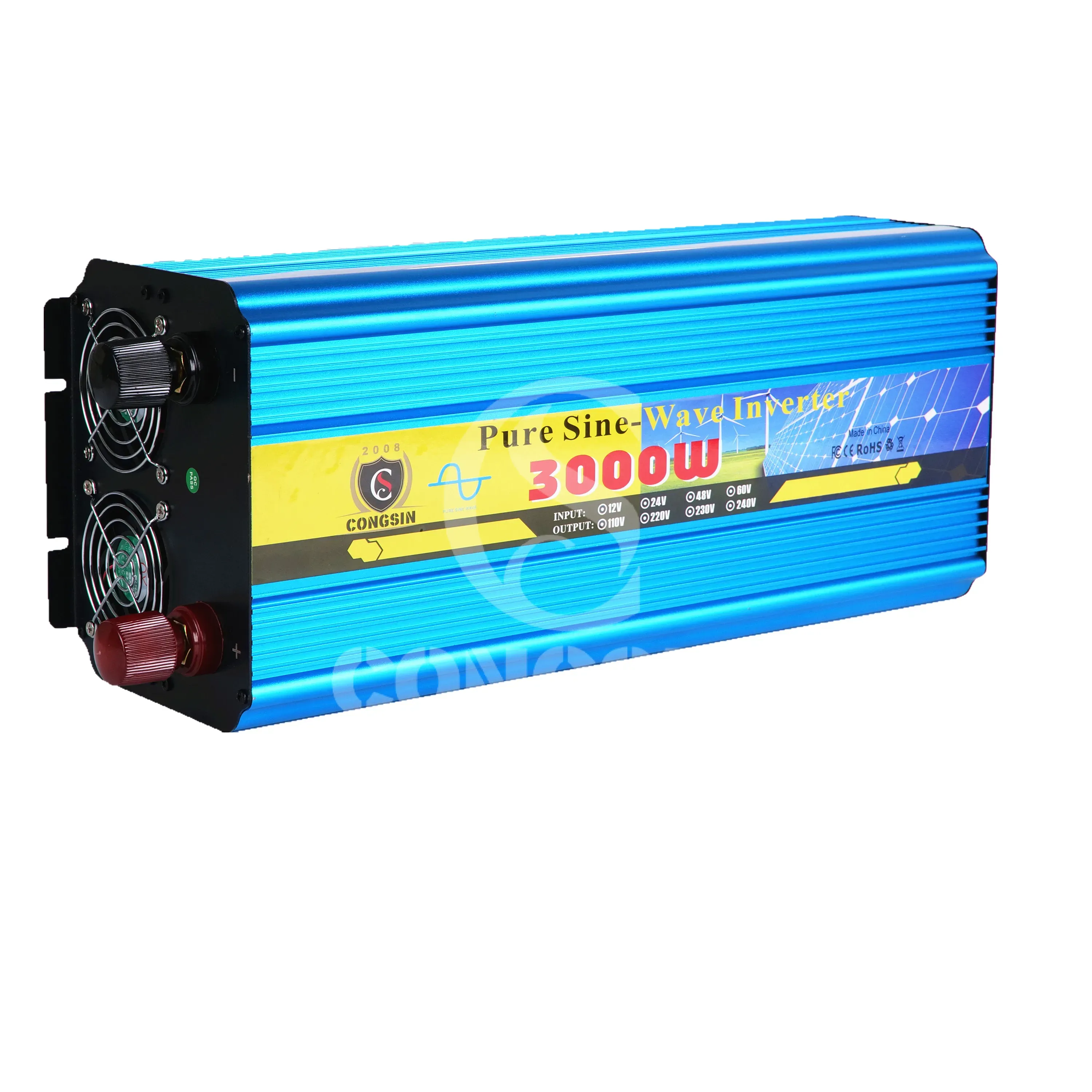
Congsin 3000W LCD Pure Sine Wave Inverter for Home Use Solar Backup Power Inverter Off Grid UPS
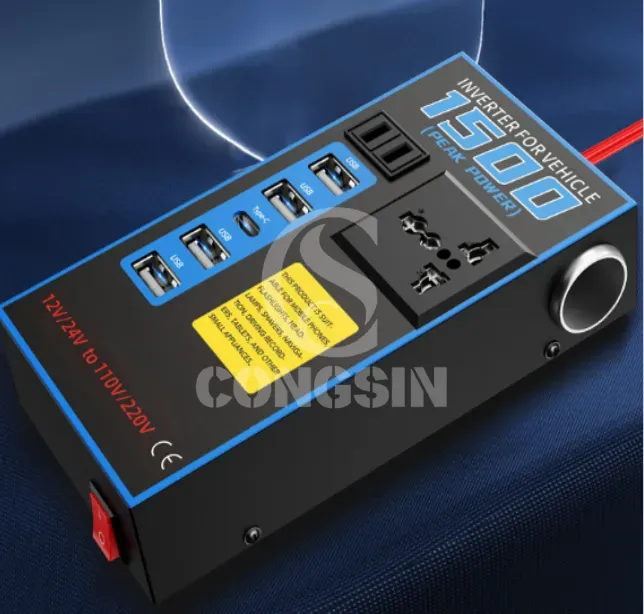
Congsin 1500W Inverter for Vehicle DC 12V/24V to AC 110V/220V with Universal socket Modified Sine Wave
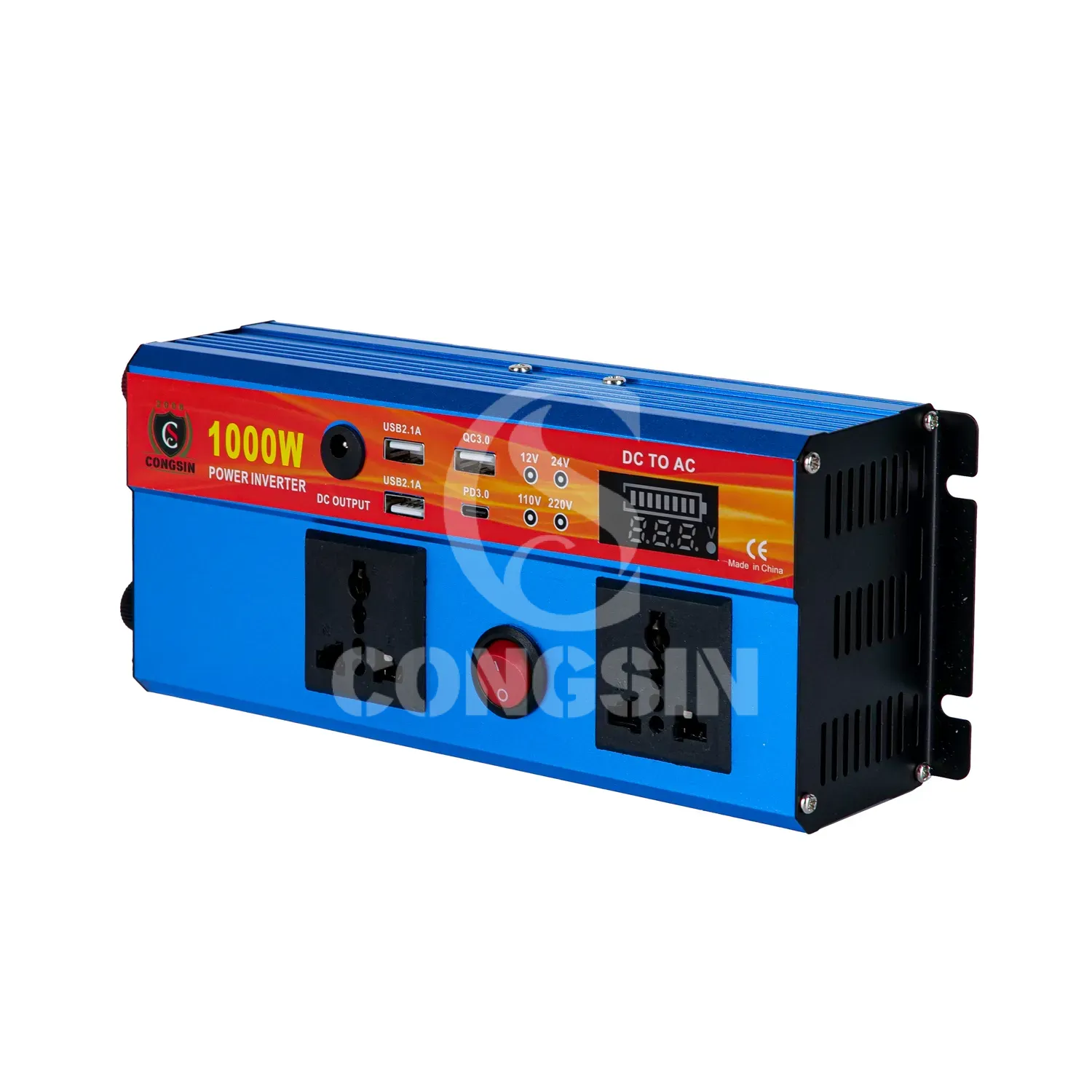
Congsin 1000W modified sine wave inverter with LED display and Type C port car RV power inverter
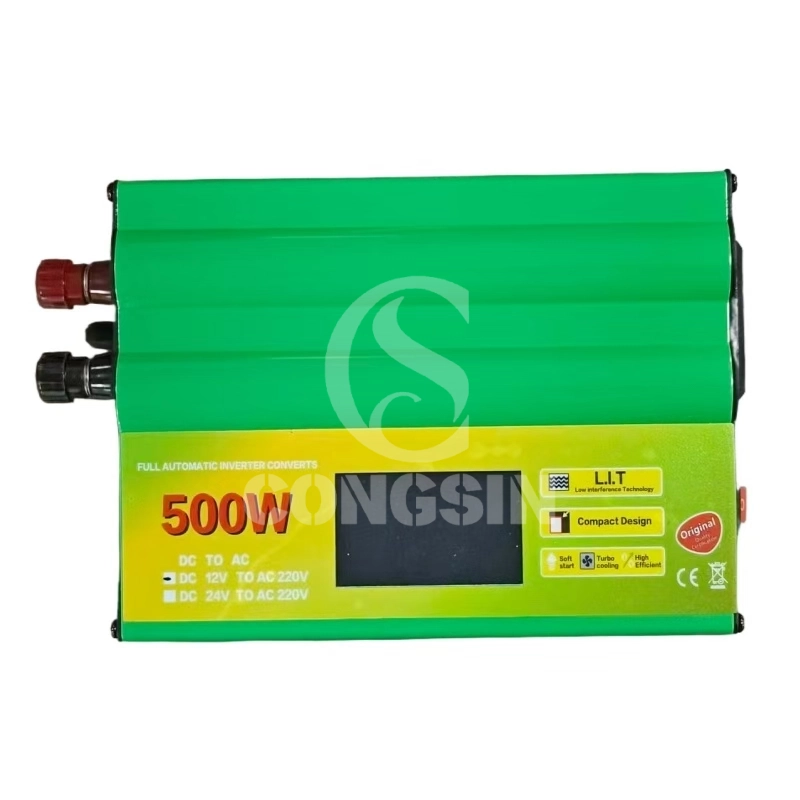
Congsin Modified Sine Wave Inverter 500W 1000W 1500W 12V LED Display Portable for RV Car Solar

CONGSIN is a trusted OEM factory for power inverters, solar charge controllers, and DC converters. Reliable solutions for global B2B buyers.
 High Quality
 7/24 Service
 Guaranteed Warranty
© 2025 Congsin. All Rights Reserved.